
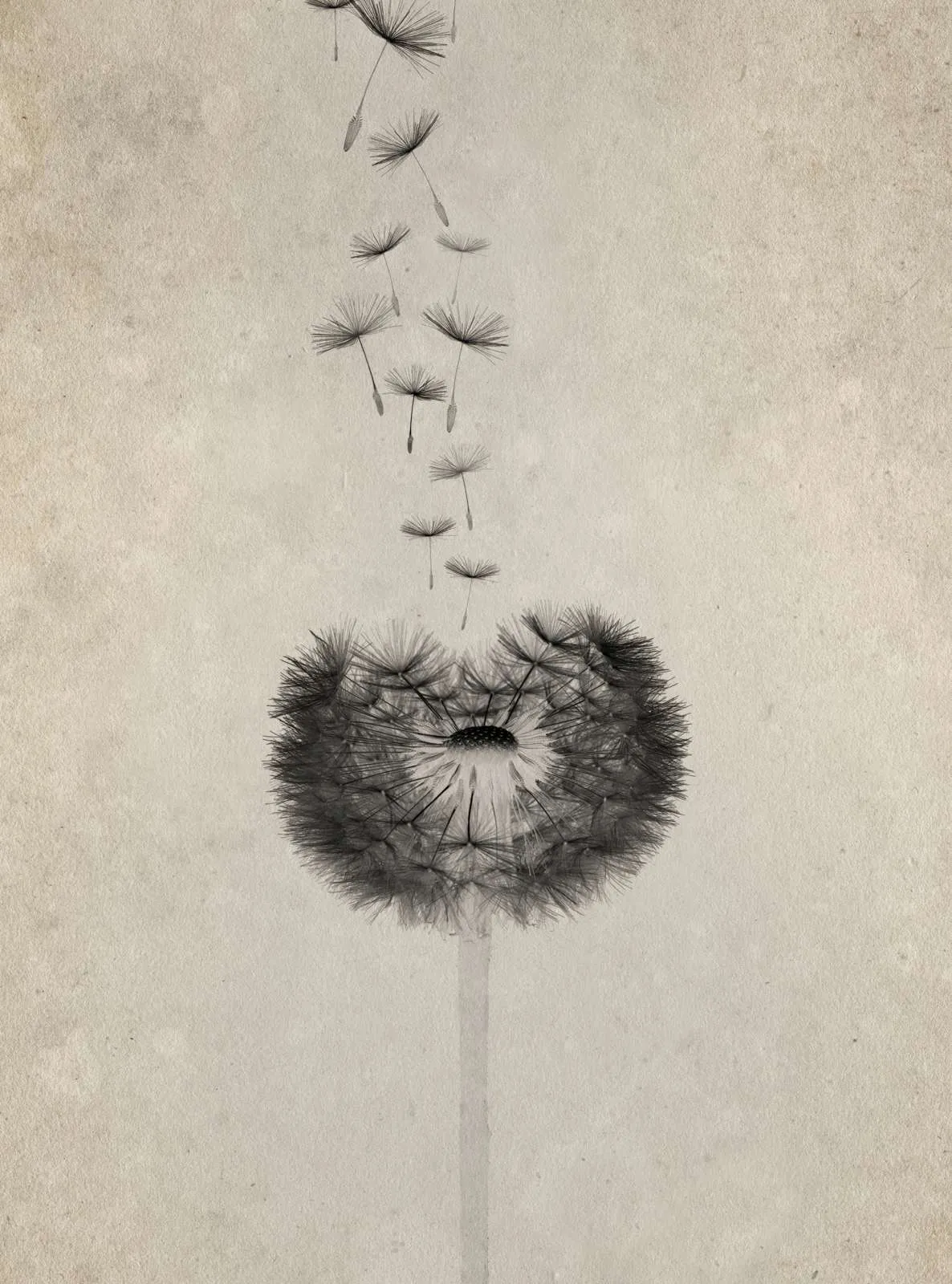

We banish death, and yet it surrounds us, brought into the world by us. How can a new relationship with dying give us new life? And contribute to a transformation of our society that connects us to the greater realities of which we are always a part?
It was an experience that stayed with me. In the summer of 1994, I sat in a boat in the middle of the Ganges near Varanasi. In front of me, countless meter-high, blazing and smoking pyres burned on the banks of the river. On them lay the bodies of deceased people. The smoke and the intense smell gave the scene an archaic quality. For 3,000 years, devout Hindus have been bringing the bodies of their loved ones to this holy city to consign them to the river as ashes. Death was at the centre of life.
From the small boat on the Ganges, this sight seemed to me like something from another universe – both disturbing and fascinating. The matter-of-factness of death as part of an eternal cycle of coming and going was a world away from my European experiences with death.

Death Banished
We know that we have banished death from our society as far as possible. Most recently, the COVID-19 pandemic was a reminder of how helpless we are as a society in the face of the phenomenon of dying. Many measures were perhaps understandable, but they nevertheless revealed our cultural approach to death and dying. We were only able to respond to this deeply existential situation with technocratic measures. This, too, revealed our society’s inability to face death. Yet it is precisely this inability to perceive a reality beyond our technical systems that is one of the reasons why we are threatening the foundations of our existence. Ecological destruction and climate change, with its already noticeable consequences such as escalating forest fires and typhoons, are destroying the habitats of many plant and animal species, and also of us humans. The endless growth that continues to shape our modern societies is a deadly spiral.
In addition, our seemingly deathless society has also banished mystery. Death forces us to confront the great mystery, the great unknown. It is precisely the end of our lives that forces us to grapple with the question of who we really are and what we live for. In our open society, there are countless answers to these questions, but can we nevertheless overcome our avoidance of death together in order to understand ourselves once again as part of the great cycle of life?

A History of Death
In our modern culture, we come into life alone and leave life alone. This was not always the case. In indigenous societies, we were primarily part of a lineage of ancestors in which life was passed on. In these societies, we received life from our ancestors and pass it on to our children. In rituals and ceremonies, the ancestors are available as advisors, and the traditional teachings of the ancestors are faithfully passed on to future ancestors, our children and grandchildren. One is part of an ancestral line within the larger lineage of a common people. This ancestor worship still lives on today in the household altars of many Chinese and Japanese homes with their pictures of ancestors, but also of grandchildren, surrounded by gods and bodhisattvas. Among some indigenous peoples of America, a murderer must take the place and name of the murdered person in the family to restore their ancestral line. These animistic cultures saw themselves as part of a process, a great becoming and passing away.
Our Western tradition’s relationship with death is based on ancient Egypt. Perhaps like no other culture, the Egyptian pyramids have created a monument to death, but also to transcendence. When one considers how much social labour must have gone into the construction of these gigantic stone monuments, one can imagine how central the realm of the afterlife was to the Egyptians. In ancient Egypt, a different conception of death was the focus of attention: not the eternally continuing ancestral line of life, but the relationship to another world outside of time.
The Abrahamic religions are, so to speak, the heirs of this Egyptian conception of the afterlife. In this tradition, we are dual citizens of this world and the next, and our death is also a homecoming to that other world. Egyptian cosmology gave rise to a perception of the unchanging, the eternal, the timeless. While indigenous cultures sought the sacred primarily in the eternal flow of life, here a conception of the sacred as the origin of all life emerged. These experiences of the sacred shaped the spiritual traditions’ ideas about death as a transition in the eternal flow of life or as a reunion with the origin of all being. Our medieval monasteries were part of this culture, which also saw death as a homecoming to the origin.

Kierkegaard and the Sickness unto Death
Modernity has completely changed our relationship to death. And no one addressed this radical change earlier than the Danish philosopher and founder of existentialism, Sören Kierkegaard. He lived at the beginning of the 19th century in a European society that was rapidly beginning to abandon its relationship to transcendence and the dimension of the sacred. Inspired by the scientific, economic, and imperialist successes of European societies, people in Europe sought salvation in precisely these areas: scientific understanding of the world, economic prosperity, and imperial expansion of power. Kierkegaard saw himself as a voice crying in the wilderness. He was known for his sarcastic social criticism of those who believed in science and could only perceive the world in a deterministic way. His mockery was directed just as much at the petty bourgeoisie of his society, who lost their humanity in the triviality of their everyday affairs.
One of his central ideas was that enlightened, science-oriented, and pragmatic Christianity in Denmark at that time had lost its relationship with death. In his book “The Sickness unto Death,” he describes how modern man of his time, in his new individuality, perceives death in a radically new way. In the new emphasis on our existence as separate from everything else, we are condemned to despair in the face of death. For Kierkegaard, the only cure for this sickness unto death is an existential leap. A leap of faith, in Kierkegaard’s Christian language, our faith in God. But he also understands this call as an absurd step. For faith is based on nothing other than itself. This is the famous existential leap that he wanted his Danish fellow citizens to take. They did not follow him. Our modern society has taken precisely the direction that he denounced so vehemently in his time. The values of modernity are increasingly crystallizing around incessant technological progress.
What moves our society is not the vitality of life. We stand as separate and isolated individuals facing the flow of life. And we have often completely lost touch with the sacred. The word itself seems questionable to us. As isolated individuals, we find ourselves in an increasingly technological world that is incapable of giving us meaning and significance. And then we are suddenly confronted with an experience in which the meaninglessness of our material world can no longer be denied. Kierkegaard already saw this emptiness. His answer was to take a leap of faith.

A Good Death
There is a growing movement that wants to change the way we die. Examples of this are the death-positive movement, palliative care units, hospices, and the training of end-of-life caregivers who accompany people through life.
When I think of a good death, I remember my friend Terry Patten. Terry was a special person. He was grounded in a lifelong deep spiritual practice and an intense commitment to the world. Perhaps it was his devotion to the sacred dimension of reality that shaped his life so profoundly, combined with a deep empathy for people, including their pain. In his final years, he focused all his work on what he called “a new republic of the heart,” calling on us to become citizens of a society committed to cultivating the heart. From my conversations with him, I know how important the distinction between a sentimental heart and a spiritual heart was to him. Terry was a spiritual activist who combined recognition of real, unbroken wholeness with the need to respond with a spiritual heart to the crises facing humanity. The deadly effects of modern life on our planet pained him deeply.
A few years ago, on his 70th birthday, Terry was diagnosed with a rare, very aggressive form of lung cancer that gave him only a few months to live. Terry reacted to this news in a very unusual way. This extreme situation became an opportunity for him to engage in spiritual and activist work. He linked his own death to the dying of species and habitats on our planet. He wrote a kind of farewell letter to many of his long-time friends, without mentioning the farewell, but only expressing gratitude and appreciation for their work together. Terry organized a joint online seminar with some of his companions entitled “Brightening Every Darkness” and offered his soul power as a light in dark times. Here, too, his own death became a metaphor for how we can live on our beautiful Earth: a radical trust in life rooted in love, in the real, and embracing death as part of the great cycle of life. He held his last seminar from his hospital bed.
Terry had a good life and a good death. His lack of resistance to his mortality created a deep field of love and gratitude, trust and presence that surrounded him as he died. In this ultimate encounter with the end of one’s own life, the potential to live in the pain of the heart and open oneself to mystery is revealed.

The Preciousness of the Beating Heart
I tell the story of my friend Terry to point to the power and possibility of a good death. Many who have sat at the bedside of a loved one who was dying know that a good death, without struggle or resistance, ends a life with grace and dignity. No one knows what comes next. Trust in the great unfolding of life, which includes dying, makes us more sensitive to the preciousness of life itself. What if our actions arose from this realization?
Being confronted with our own death changes our perception of the world. We often see our lives as a story, as our own story, in which we strive to turn the next page. But when there is no further chapter to turn to, we see the book of our own life in its entirety, in a way we may not have perceived before. Closing this book also opens up a new lightness and freedom.
In the face of death, our own world loses much of its hypnotic power—all the things with which we have identified throughout our history. Perhaps that is why the many small deaths we experience in our lives are so life-giving. Everything that is allowed to die clears the way for something new. When something no longer needs to be repaired, it reveals its own special beauty.
Of course, death is a special moment of trust. Every death, big or small, is an act of trust. When we are forced to let go, it is a moment of uncertainty that confronts us with our own trust – and this applies to every existential moment for us personally, but also for us as a culture and civilization.
When I had the opportunity to speak with 97-year-old Benedictine monk Brother David Steindl Rast about this topic for this issue of evolve, he made a distinction that changed my perspective. When we talk not about death but about dying, we see how dying has always been part of life. Mortality and birth are the breath of life. Perceiving both in their unity changes my view of death. Am I able to engage with this process? Perhaps this is the existential leap that Kierkegaard speaks of. In my friend Terry Patten, I was able to perceive the tenderness, the luminous vulnerability that is revealed here. How can we, in view of the preciousness of the beating heart, of the breath and the light playing on the surface of the water, in view of the preciousness of our finite lives, which makes us aware of dying, treat the web of life, of which we are a part, so recklessly?
For dying to be part of the cycle of life again, transformation is needed. Can we trust life, the cycle of life and death that includes us?
No moment requires this trust more than the moment when one’s own death is imminent. But our everyday lives are also transformed when we are able to die in order to live and grow. And it seems that as a civilization, we also need the ability to let go of many of our own established foundations in order to give new strength to life on this earth.

2 Responses
A very beautiful and vulnerable exploration of life and death and dying. Thomas writes with hard earned wisdom born of his many decades-long exploration of the sacred core of life, and his conscious embrace of living and dying. I feel honoured to have known him, a person who lived a Good life and lived a Good death
Thomas was so right – our decrepit modern western world holds death away as much it seems as it does life . What was so refreshing travelling to Varanasi in India was to witness the timelessness of these burning pyres and the celebration of life as part of one big cycle. Because we are so afraid of death we seem intent on creating death around us, losing touch with real truth beauty and awe in the process…