

We arrived in the early morning, bleary eyed, having flown through the night with no sleep. A a short stopover in Istanbul en route. Climbing into a dusty cab at the airport on the edge of the city of Cairo, we are driven by Ahmad, a well-dressed young Egyptian businessman who drives a cab part-time. Amad speaks good English.
First impressions…a city of the desert. Sand-coloured mosques with tall thin minarets reaching into a cloudless sky. Dry heat already rising. An ominous feeling passing the two mile-stretch of army headquarters, making clear from the outset the overriding presence of the military. A perception only heightened as we enter the city itself.
We are here with our backpacks to participate in a global march from Al Arish, a small city in the Sinai desert six hours north-east of Cairo, to the Rafah border crossing with Gaza. Like thousands of others, we felt compelled to join the march, despite the risks and uncertainty, because it was something we could do, to try to affect a meaningful response from Western governments to the unconstrained bombing and starvation of Palestinian people. A war now twenty months in, whereby the Israeli regime appeared increasingly bent on eradicating an entire population.

Although the organisers had tried to obtain authorisation for the march from the Egyptian government, officials had not responded one way or the other. Despite assurances that we would respect the laws of the country and only continue the march with the necessary permissions, government officials had maintained an ambiguous silence. The hope was that the clearance would soon be forthcoming.
On this uncertain basis, the organisers, mostly diaspora Palestinians, desperate to create some traction against the annihilation of the people of Gaza, had urged all those who had registered – 5000 from 52 countries – to come to Egypt.
It was evident as soon as we entered Cairo that the Egyptian military was on heightened alert.The combination of Israel’s capture of the Freedom Flotilla, the deportation of Greta Thunberg and some of its crew, plus the publicity surrounding the march, now dubbed ‘Masirat Al Ahrar’ in Arabic (‘March of the Free’), and the Sumud humanitarian convoy of buses en route from Algeria and Tunisia, carrying aid in the hope reaching the Rafah Crossing also, had rattled the Egyptian government.

Military vehicles and trucks encircled the city centre, with a heavy police presence patrolling the streets. You could feel the tension acutely. We met up with friends in a local restaurant to hear that plans had changed. In hushed tones surrounded by watching eyes, we learnt we would no longer be going to Al Arish directly by bus, but making our own way in taxis to a small town close to the coast, south of Al Arish, where we would congregate.
At the Checkpoints
We scoured the streets for a suitable cab, most of which were in poor shape with drivers that didn’t want to leave the city. We finally settled on an enthusiastic older gentleman with a kind smile, who owned a battered taxi that he was clearly very proud of.
An hour or so later, we reached a tollbooth or more accurately a checkpoint where cars were heavily backed up. We spotted groups of Western activists who seemed to be waiting for permission to pass through. Not good. Thankfully we didn’t stop. Our canny driver managed to find a way through the queues on the far lane, and we kept going.
Two hours later, we hit another checkpoint. This time the back-up was huge. Nothing was moving and there was a cacophony of blaring horns. By now the heat was brutal. Our driver became increasingly agitated, mystified at the cause of the standstill. A policeman appeared at our window asking to see our passports. Without a word he took them, and walked away.

Once we were out of the taxi, we understood from the hundreds of others gathering around the check point area, that everyone’s passport had been confiscated. As the inevitable impacts of the blockade on local Egyptians, who were not involved in the march became apparent, this gave us pause for thought. What’s more our taxi driver’s engine overheated in the wait, and despite attempts by other drivers to help, it was immobilised and needed to be towed back to Cairo. Our driver was desperate, the cab was his living, and he could not afford the fee to have it fixed. We gave him the extra money needed to cover this and he kissed us in gratitude.
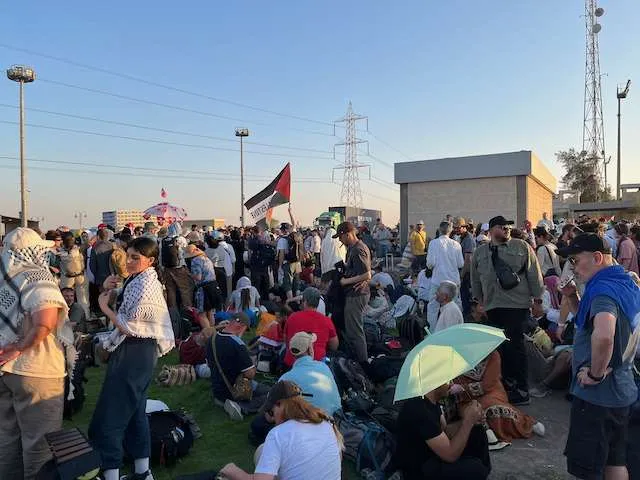
As the afternoon progressed, the group began to grow exponentially. We were soon a thousand people from more than forty countries, both small and large – from Australia and New Zealand to Mauritius,Turkey, South Africa, Jordan, Malaysia, Japan, multiple European countries, and many others. As the afternoon wore on, it began to look increasingly as if the Egyptian government was not going to allow us to march. We began to learn that whole groups, particularly from Muslim countries, were being detained and deported. But despite this news, the 40 plus degree heat, and long queues for snacks at a small café on the side of the road, the atmosphere was extraordinary.
Free Free Free Palestine
There was a felt sense that we were a ‘global community’, united in standing for humanity and the human rights of innocent civilians. A calm solidarity was palpable in all our conversations, in the sharing of scant food and water, and in the tangible transcendence of tribe, nation and ethnicity. Small spontaneous acts of kindness conveyed this: the German woman sharing a cigarette with a young army officer, his rifle swung across his shoulders, who returned the gesture with a plate of flatbread; an old Algerian man sharing his homemade pastries from out of a dusty suitcase; the patience held by everyone, as we waited long hours in the heat to see what was going to happen next. And, given the context of the march, the absence of anti-Israeli or antisemitic rhetoric was noticeable.

Suddenly, without explanation, police officers and military officials began to release huge bundles of passports from the back of a pick-up truck. Activists climbed up to join them, countries and names were shouted out. This went on for hours, but there was no acrimony from either side. As activists, the uncertainty had already been embraced, and we were simply going with what we had no choice but to accept. Meanwhile, the police officers were genuinely enjoying the novelty of the event. Young Egyptian teenage military police wearing battered riot gear were commandeered to watch over us all. Most of the time they were smiling, chatting amongst themselves. Some people shared food with them. It was clear they were not sure what they were supposed to be doing.

Darkness Descends
Later into the evening, however, the atmosphere began to shift. A senior police officer arrived and talked to the whole group, at least to those who could hear him. He told us we could not stay at the checkpoint (sleeping bags were already being laid out on the ground); nor could we continue the march. He gave us a mandate to either leave for the airport by taxi, or return to Cairo, or be deported. Some people spoke out and objected strongly, arguing by what law the government could do this? But it struck us both that this was not our country. We were not in Europe. What right therefore, did we actually have to dictate the terms?
On one hand, why should we not be allowed to march? After all, prohibiting it, directly contradicted Egypt’s own position of support for Gaza. On the other hand, Egypt would almost certainly be under pressure from Israel to make sure this march didn’t happen, including threats to cut off its gas supply. But despite all this, something significant had already happened. Something beyond ‘us’ and ‘them’ and all the compelling narratives surrounding this binary.
Meetings were held according to our different countries of origin to discuss the situation. The vast majority, including both of us, decided to stay put. Perhaps, we thought, we could even march from the checkpoint in the morning. But there wasn’t to be a morning.

As the evening hours crept by, the police brought out a fire-engine and began to ominously unreel a large hose through the crowd. The anxiety level rose. Suddenly water issued into the air, and the group of young riot police were directed to slowly kettle us all. Bottles were thrown into the crowd, which we later understood were thrown by provocateurs hired by the military. Plain clothes thugs and police appeared on the sidelines, actively trying to force us into coaches and minibuses hired by the government. Some activists were beaten. Our collective began to disintegrate. Finally, late into the night, it was clear we had no choice but to leave, or real violence would ensue. Once again, the crucial position of non-violence was ever more evident to us.
Traveling back to Cairo in a small minibus, yet another chapter unfolded when the driver inexplicably stopped his vehicle and walked away in the middle of a four-lane highway!. He refused to take us further unless we paid him more money. We were all exhausted, but the three Egyptian passengers were enraged. For them it was a matter of dishonour that the driver had refused to uphold our agreement. Finally, after much shouting, the driver reluctantly returned, and we resumed our journey. Our Egyptian co-travellers immediately appeared to forgive him. “We hate him, and we love him”, they said cheerfully. “He supports our cause”. From then on, all three engaged in loud but friendly dialogue for the rest of the long ride to Cairo. Human solidarity, it seemed, trumped pride and anger.
A New Day In Cairo
The next day we found our way to a prominent mosque on the edge of Tahrir Square in central Cairo, a landmark that still holds a place in our hearts with the memory of the massive crowds televised in 2010, celebrating what was heralded as the Arab Spring, and the hope this inspired across the world.

Arriving at the mosque, we were unaware that it was exactly the time of prayer. We entered unhesitatingly, seeking quiet contemplation. Not wishing to stand out, Steve sat at the back on a chair next to an elderly man who greeted him, as the Imman began the prayers. Mary, with her head covered, slipped into the women’s prayer room. People filed in from the blazing heat on the street, old and young, including many young soldiers, who removed their headgear as they kneeled to pray. All kneeling together is one of the powerful expressions of equality in Islam. Prayer, a momentary balm to the rigour and strife of life outside this cool and harmonious space. At the end as we all stood up to leave, the elderly gentleman next to Steve, shook his hand and smiled.
Blinking in the sharp light as we left the mosque, we felt a relaxation come over us, after the tension of the last 36 hours. Walking along the Nile, shimmering radiantly off into the horizon, we pondered the complexity of the extraordinary history of Egypt and its legacy as one of the greatest civilisations of the world.

Something was shifting in the city. As watchful as ever, the police were no longer spying on us in the cafés. We learnt that the police trucks around the square were not specifically to do with the march. They are always present; the result of a strict law against mass gatherings of Egyptians in the city centre. This is, apparently, to guard against any remote repetition of the events of 2010.
In the little cul-de-sac outside our hotel, a huge police van remained implacably parked. Its officers checked our coming and going. Meanwhile, in the alley beside it, small city cats delicately sipped water out of MacDonalds plastic cups, provided by the locals.
While various negotiations were taking place with consulates by the march organisers, we continued to wait to see if we would be given permission for any kind of gathering in the city. it was during these days we learned that Israel initiated strikes on Iran. Inevitably, all around the Middle East there was heightened vigilance.

Egypt is a police state, and there is no doubt terrible injustices are happening there, perhaps every day. And yet, reflecting on our truncated march, and the powerful solidarity that was shared together across nations and faiths, alongside our brush with the state, we had no regrets about coming. We also heard that Palestinians in both Gaza and the West Bank rejoiced at the fact that people from so many disparate nations, had not forgotten them.
We were left with the reflection that beneath the stereotyping, the binaries and narratives that we all hold about each other, most people as demonstrated by the global scale of both the march for Gaza and the flotilla, actually do care. And the reality is, unlike many of our governments, ordinary people do not want war. Most simply just want to get on with their lives, to go to school, to be able to work, to feed and protect their families—to live a full life.

2 Responses
Thanks, Steve & Mary for sharing your courageous journey across Egypt in support of the horrific suffering of the Palestinian people at the hands of the Israeli government. You demonstrate how vital it is for us in Western countries not to just feel helpless nor to normalise such crimes, but to take action.
It’s moving to hear of the unity and peacefulness among the thousands of participants from many countries. It restores faith in humanity and far from being a failure, the march demonstrates how most people do care and don’t want war.
Thank you for sharing this Steve and Mary. I found the humanity of your story very touching like the taxi driver, police returning your passports, the young soldiers. We constantly hear such terrible news…terrible it is, continuously, but we rarely get a sense of spirit and care which this story conveys.