
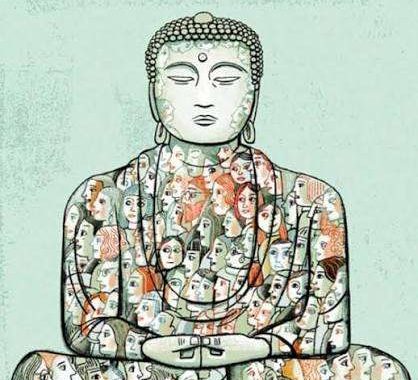

I’ve been reading and recommending Pema Chodron for years. When Things Fall Apart helped me survive periods of grief I didn’t know how to metabolize. Her books argue that pain doesn’t need to be conquered to become liveable. This idea has been lifesaving for me. I understand why anxious, lonely, frightened people standing in the wreckage of ordinary life return to her language of warmth, non-resistance, and staying present with discomfort. I do this too.
But Ezra Klein’s recent interview with Pema Chodron pissed me off.
I don’t have a problem with meditation; I practice it. I also don’t have a problem with the idea that panic compounds suffering, or that learning to tolerate uncertainty will enlarge your life. The issues here are timing, context, and political function.
Klein is a political journalist whose project emphasizes coalition-building, persuasion across difference, and accommodation to existing constraints. For example, he wants Democrats to run anti-abortion candidates in red states to win back the House of Representatives. He’s argued, repeatedly, that vulnerable people should absorb loss in the short term as an electoral strategy because moderation is practical, and coalition breadth matters more than ideological purity.
The recommendation that women tolerate diminished bodily autonomy, or that trans people accept the denial of their personhood for strategic gain, and the recommendation that individuals “agree” with discomfort, belong to the same moral universe. The promise is always that endurance serves some greater good: electoral viability, coalition breadth, personal growth, wisdom. The register [context] may change, but the underlying ethic remains stable. Accept constraints. Sit with disappointment. Endure compromise. Learn to become larger than the conditions. Learn to survive losses you didn’t choose, because refusing them is impractical, polarizing, or politically inconvenient.
So, when Klein invites one of America’s most influential Buddhist teachers to discuss “agreeing with fear,” “collaborating with reality,” and becoming intimate with suffering, during a period many people experience as organized violence, it begs the question: when does acceptance become adaptation? When does equanimity become a technology for enduring conditions that ought to be rigorously opposed?

From Structural Causation to Personal Psychology
Liberalism has long produced a familiar reflex in moments of institutional failure: it moves from structural causation to personal psychology, replaces analysis and action with resilience, and shifts attention from what produced the harm to how individuals might endure it.
Under this logic, burnout is a mindfulness problem, precarity is an anxiety problem, loneliness is an attachment problem, and democratic erosion is an issue of emotional regulation. The structures remain untouched while subjects become more adaptable.
You can hear this movement repeatedly in the interview. Klein returns over and over to his own uncertainty and difficulty tolerating anxious states. Chodron answers with the language that made her famous: befriending fear, warming toward suffering, dropping the storyline, softening resistance. The emphasis remains interior: the body, the nervous system, the gap in the breath, the possibility of relaxing with what hurts. I’ve found these techniques psychologically useful. But booking an influential Buddhist teacher on a political podcast to talk about “sitting with discomfort,” during a period of active democratic erosion, reads to me like the liberal elite’s therapeutic alibi for political quietism. It’s “equanimity” as an aesthetic.
Klein’s politics has increasingly become a form of managed ambiguity: thoughtful, curious, non-absolutist, reluctant to condemn, allergic to certainty. These are methods of evasion: studied openness, the supposed suspension of judgment, the insistence on complexity. Curiosity becomes a virtue in itself. But at a certain point you start wondering when curiosity stops functioning as inquiry and becomes avoidance, when complexity becomes an excuse, when understanding becomes a way of indefinitely postponing judgment. The interview with Chodron feels like the clearest articulation of this, and the most dangerous. A politics of managed uncertainty is useful in ordinary times. During an active assault on democratic institutions, it’s a sedative.
Universalizing Suffering
Suffering isn’t always just the way it is. Sometimes it’s historical. Humans were enslaved in America for 250 years. Sometimes suffering is politically administered. We need more than curiosity about what that suffering was like; we need to understand the afterlife of that institution and dismantle the infrastructure that’s still producing it.

Ta-Nahisi Coates [African American writer] pressed Klein on precisely this point. His argument was that public conversation repeatedly launders historical harm by shortening memory and universalizing suffering, converting “someone did this” into “life is painful,” flattening the distinction between administered suffering and the ordinary losses of being alive. Once you stop naming who built the conditions, politics collapses into temperament. Structural violence becomes tragedy. Tragedy becomes inevitability.
Sometimes suffering is the consequence of policy, policing, colonialism, warmongering, extraction, abandonment, or institutional design. To universalize suffering risks flattening those distinctions. It changes the moral atmosphere and diffuses responsibility.
This is the move Klein makes over and over. Political conflict or structural failure gets translated into temperament. Institutional harm becomes emotional burden. Political injury becomes a question of resilience. The burden shifts from systems to subjects. The onus is put on your personal investment in learning to hold ambiguity better, tolerate uncertainty longer, cultivate enough interior spaciousness to survive, not just disappointment but outright attack. As a public philosophy it’s profoundly conservative because it shifts emphasis from altering conditions to enduring them.

[Throughout the interview] Chodron repeats: “Agreeing.” Agreeing with fear, agreeing with uncertainty, agreeing with discomfort. [However], agreement acquires a different character when transported into politics. Entire populations are routinely instructed to collaborate with realities they didn’t choose. Workers collaborate with insecurity. Patients collaborate with inaccessible healthcare. Women collaborate with legal restrictions on bodily autonomy. Palestinians are told, endlessly, to collaborate with their own slaughter. Agreement is not a substitute for resistance.
The Intersection of Abuse in Spiritual Lineages and Liberal Politics
Pema Chodron herself complicates any attempt to treat her solely as an apolitical grandmother dispensing universal wisdom. Her rise occurred within Shambhala, the organization founded by Chogyam Trungpa, a teacher with documented histories of abuse, coercion, and cultic control. He was a fan of fascist aesthetics and had several very young “spiritual wives.” Buddhism has animated antiwar resistance and self-sacrifice; it’s also been absorbed into corporate wellness culture, productivity literature, and therapeutic individualism. Which [form] of Buddhism one chooses, tends to reflect who’s doing the selecting.
Chodron didn’t create those structures [at Shambhala]. But the question remains: can traditions centered on transcending ego, accepting reality, and softening resistance, become unusually vulnerable to minimizing harm when harm originates within their own hierarchies?

What happens if anger becomes attachment? If resistance becomes evidence of ego? If acceptance becomes wisdom by definition? The question stops being whether abuse existed inside a spiritual institution. It becomes whether certain contemplative frameworks are structurally bad at recognizing abuse, because accountability itself is seen as spiritually immature.
And if that’s true, the vulnerability extends beyond Shambhala. What is Klein’s political method, if not a secular version of the same impulse? De-escalate. Stay open.
What happens when a politics organized around equanimity encounters power that is perfectly comfortable with certainty? What happens when non-attachment becomes inability to name domination as domination?
A politics that treats strong judgment as evidence of closed-mindedness may become structurally incapable of recognizing power as power, or harm as harm. At some point “holding space” starts to become indistinguishable from accommodation.

Two Versions of Spirituality
I’ll always have a soft spot for Pema. I think many people, including me, have found something instrumental in her writing. Which is partly why this feels worth examining. Useful teachings can still serve conservative functions when imported into politics. Comfort can become ideology. Compassion can become accommodation.
There is a version of spirituality that deepens courage because it reduces the fear of discomfort. And there’s another version that teaches people to endure suffering indefinitely. Klein’s interview with Chodron didn’t directly answer the question of what kinds of suffering require acceptance, and what kinds require refusal, beyond Chodron’s admission that victims of domestic violence should leave their abusers.
Her exception does reveal a threshold.
Even within her framework there are conditions severe enough that endurance ceases to be wisdom, and departure becomes necessary. Some realities should not be collaborated with. Some suffering should not be metabolized into growth. The question isn’t, therefore, whether a threshold exists. The question is who gets to decide where it sits.
Klein’s threshold is very high. He wants us to endure electoral compromise, coalition politics, and the slow erosion of the survivable conditions of personhood because certainty is perilous, and accommodation is practical. This is what makes him dangerous: his method produces, in the people who adopt it, an increasing tolerance for what should be intolerable.
Entire political traditions are built on confusing endurance with virtue. Resilience and acquiescence are not the same thing. Acceptance and surrender are not the same thing.
We were never supposed to become better at surviving abuse. We are supposed to stop it.
Edited from the essay, The Problem with Pema Chodrun by Erin Williams
