
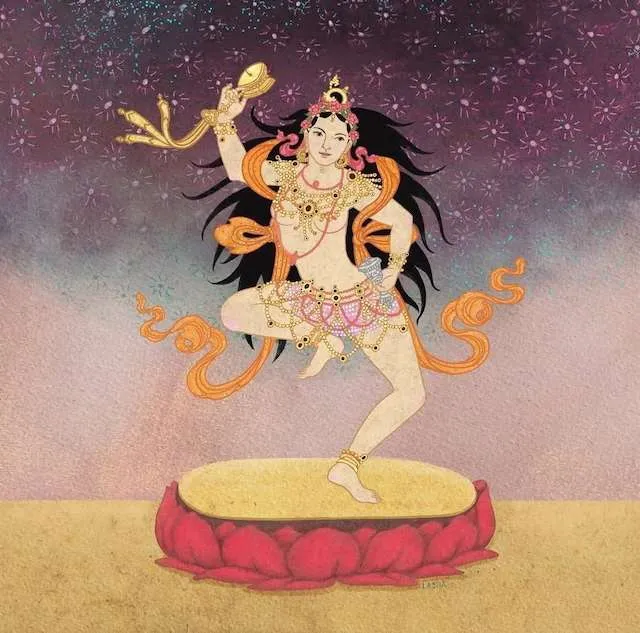

Faced with the diagnosis of a life-threatening, or chronically debilitating disease can feel like staring into a dark abyss… from which there is no good outcome.
Seven years ago, this happened to me when, finally, after many months of increasingly alarming tests – a neurologist said to me,” You have Parkinson’s disease”. As these words sank in, I heard him say that I could expect five good years, at best, and then life would start to get increasingly difficult and disabling.
For a while I tried to avoid the abyss with my habitual modus operandi of “I can handle this”, which kicked in immediately.
Some months later, I had a realization that whatever I had been doing previously to live a healthy, self-aware life was profoundly ineffective now. It was a shock… I started to look into the abyss and two paths revealed themselves.
The first was to continue what I had always done to stoically handle what life threw at me, despite a voice lurking in the background, whispering ‘why me/ life’s unfair/ what did I do to deserve this etc.?’ Or worse, ‘you must have brought this on yourself….’
I saw clearly in that moment that if I kept on this path I could manage, maybe even enjoy life for a while… five years?
Another path, however, drew my attention. The message here was radically different, ‘This entire situation is exactly what you need, even if you don’t realize it! Accept it fully and find out what this disease means for you.’
Out of the abyss of hopelessness, a door opened to the idea of a whole new perspective. I knew that the choice of walking through that door was an uncompromising one. There would be no days off, no refund. But I knew I had to choose this. It was the way for me.

Radical Acceptance
So, what does walking through the door of radical acceptance mean? Initially, it means recognizing that everything that has happened, is happening, and will happen, is not a mistake. It’s not bad luck. This includes everything, with no exceptions. It’s a big ask, with profound implications for any human being for it removes the sense of victimization, and it requires us to place our trust in a greater intelligence.
What does this mean?
One of the main elements of radical acceptance with no fine print, is an attitude of surrender. ‘Surrender’ is often a negatively loaded word associated with weakness and giving up, handing over control. It’s something that can terrify us. But surrender, in this context, means letting go of the idea that I am ultimately in control, and letting in that there may be forces beyond the realm of what I know, and think I control.
In our secular environment, this might sound like new age woo woo. But it’s not. It’s an attitude of mature trust, not naivete. A trust revealed, when the superficial noise of our personal and cultural beliefs and conditioning is stripped away, in a greater intelligence in which the natural laws that govern my body, all bodies, human or otherwise, are the operating system of a whole, perfectly functioning organism.
It is extremely difficult to trust in something that appears to have brought such problematic results (in my case, a neurological disease). Similarly, it’s very difficult to trust when the world seems to be going to hell in a handbasket, with me in it. Yet, this kind of trust says that everything that is going on in my body, in my life, is as it should be, and I can let go. Am I advocating an attitude of passivity? No.
For myself, with symptoms that were so limiting and soul destroying, such a radical acceptance only started to make sense after I decided that no matter what occurred, I was not going listen to the victim mind.
Symptoms force us to change. In my case, I could no longer work as I wanted, could not focus, had severe fatigue, tremors and generally felt unwell with bouts of depression.
The abyss of the Buddha’s three classic fears: old age, disease and death. We all face these fears at some point, usually later rather than sooner. For me, it was much sooner than I expected.

The Journey
The buzz word in the scientific/medical community is neuroplasticity. It involves the forming of new neural pathways in the brain, strengthening existing connections, eliminating outdated ones, acquiring new skills, recovering from damage, and fine tuning the brain for increased efficiency. This is facilitated primarily through the mind, they say, and change in the mind comes as a result of self-enquiry.
My understanding is that the brain does its best to adapt to life’s external stresses. But if there is damage to the brain, what then? Neuroplasticity says that even then, new pathways can be created. But, making changes is difficult, especially when we have become hard-wired over decades to behave habitually.
Self-enquiry, in this context, required and still does, examining my life in every way to see what needs to change. Naturally, I meet with my own resistance, and it can seem easier to just add another supplement rather than facing what Eastern spiritual traditions refer to as ‘binding vasanas’, or deep-seated mental tendencies. These usually unconscious tendencies are so deep-rooted in our sense of ourselves, formed in early childhood or even genetically, that we take their existence for granted.
For myself, I had a need to prove my worth, and the force of this compulsion drove my life choices. For any of us, such compulsions are often relentless, never satisfied, no matter how apparently successful we feel. To reverse such compulsions takes clarity about what they are, combined with the conviction that they are inimical to our wellbeing. We could even substitute the word addiction, meaning anything that I feel uncomfortable not doing! We all love our “comfort zones”, and giving up everything that I find to be inimical to genuine well-being can seem daunting, requiring a level of determination daily.
Dis-ease affects us on all levels of being: physical, emotional, mental. Physical change is the low hanging fruit because making tangible changes to diet, exercise and lifestyle is proven to be effective, and although not easy for many, is not too difficult to change. For example, I have chosen to commit to a rigorous exercise regime that has become more enjoyable than I ever imagined. Last year I was unexpectedly invited to walk the Camino de Santiago – a pilgrimage route of 175 miles through Portugal and Spain, and in doing so was able to fundraise for Parkinsons Disease.

Dis-identifying with Emotional States
There is a greater challenge emotionally. I am aware of how this disease affects the chemicals in the brain (primarily dopamine) causing negative states of mind that feel so real. I have learned to observe changing emotional states without identifying with them – to watch them come and go, untouched by them for the most part. For example, when I wake up in the morning, there is often discomfort. But there is no mental suffering if I avoid the temptation of the abyss, of reverting to victimhood.
Openness to life itself brings a natural gratitude and deep relaxation that pervades one’s experience – a radical acceptance. There is freedom to be both receptive and responsive. New horizons present themselves in ways my former self could never have envisioned. Answers always come, often in the most unexpected ways.
On a mental level I re-evaluated my values. Peace of mind now takes priority over former ego-driven desires. I have seen how my former life was driven by self-imposed pressures that seemed so compelling but created unexamined stress. It was the compounding of many stresses, physical and mental over decades, that was more than my nervous system could handle. Parkinsons stopped me in my tracks and gave me a chance to change. The mental level is where the rubber truly meets the road, as deeply held ideas and beliefs are all up for re-evaluation, without a shred of blame or guilt.
I am finding there is a quiet inner confidence that is the guiding light of my daily experience. My attention has shifted, focusing on what each day brings – open to what I am being shown or asked to do, without judgment or manipulation on my part. It may sound like a cliché, but I do feel increasingly, that my life is an instrument of the life-force flowing through me.
As desires and aversions lessen, and therefore, personal judgments, the subsequent compulsion to manipulate life to suit my individual needs, is lessening. One of the many benefits comes in the forming of deeper personal connections, and a genuine experience of unity.

Aligning With a Greater Intelligence
Nothing here is new or unique – many take this path and flourish as a result. What is significant is that although for me this change of attitude came because of disease, we all face the same choice at some point, whether we acknowledge it or not. Humanity is facing an existential crisis of unprecedented proportions – we are all facing the abyss, and the question is the same for all of us, both individually, and ultimately as a species – carry on as before, or make a radical change?
Change seems so impossibly daunting until we fall to our knees in despair and ask for help. We imagine that we must do something, as opposed to letting go of ‘my life’ / ‘my way’, aligning ourselves with a greater purpose and intelligence, in whatever form that takes.
As human beings we identify as ‘doers’, which is all well and good if our doing is for the good of the whole, and not simply driven by our own individual likes and dislikes. I make no claim to having cracked the code, but my experience of serious illness, and starting to change, has gifted me with deeper relationships, with creativity and spontaneity, with less fear and more love, fun, and joy, and most of all, gratitude.
I technically still have a diagnosis of Parkinsons, yet I find myself living a truly joyful life that feels deeply right, and full. I have a sense of purpose that is not in doing, but in being.

2 Responses
A really excellent article , thanks – deeply familiar and yet always inspiring to hear 🙏
I just found this article thank you. It is beautifully written and so genuinely deeply humbling. There is so much to share I don’t know where to start, lessons at every turn it seems.