

Some years ago, I received a lesson in humility that I didn’t expect. I had invited the renowned Indigenous leader and flute player, Tiokasin Ghosthorse, to lead an online session where he spoke about the living ever-presence of Wind, the source of his music. Wind, along with Earth, Fire, and Water, provide a knowing from the Earth, he explained. He also noted that his language has no word for domination (nor for humility, charity, or hope, for that matter).
At the end of his talk, he said that his people are taught to listen—to listen to the Wind and the elements. I responded by suggesting that, in the next meditation session, participants could listen to the Wind around them and in their breath. Tiokasin stopped me, asking if he could add something. “Yes, in the Lakota ways, we are taught to go to nature to listen. We are called to nature to hear how the Earth listens to us. That’s the complete thought: How does the Earth listen to us? How does the Wind listen to us? You see, it is much more than our benevolence as human beings going to nature and applying our thought that we can actually listen. Where is the proof that we do listen? Because look how the Earth is suffering because we don’t know how to listen and we think we do.”
Suddenly, something shifted. It was as if a bubble that I didn’t know that I was in had popped. A door to another perception opened. I felt held and whole, seamlessly part of something greater than myself. Rather than putting my attention on the Wind, as if it was outside me and I was greater than it, I sensed the intelligent presence of Wind that was both in me and around me. Actually, such division doesn’t capture the wholeness of this perception. In it, I experienced what I could only call humility. My feet were on the ground; I landed in an appropriate and grateful relationship with all that is.
My intervention in the online session with Tiokasin—to invite participants to listen—revealed that my usual position lacked this deeper humility and appropriateness. This was what Tiokasin had been pointing to. How often do our efforts to create change come from the ways of thinking and being that are the source of the problem? Or as renegade psychologist Bayo Akomolafe provocatively asks: What if the way we respond to the crisis is part of the crisis? As one alarming event after another rocks the stability that so many took for granted, humility may seem strange or even absurd to turn to. But humility may be the most appropriate response available to us. It holds a potential that we rarely perceive.

From Power to Virtue
Humility is certainly not a word on everyone’s lips these days. In a global social reality where competition for attention is not just about self-aggrandizement but survival, hubris seems more the accepted norm. The wealth gap, shrinking opportunity, and struggle for meaning in life are sources of humiliation in a society that assesses value only in terms of money. Ironically, defending against humiliation often triggers victimized pride. Thus, even the idea of humility seems irrelevant and counterproductive. Humility and humiliation are about relationship: do we engage eye-to-eye or with the eye to dominate the other? Do we create a virtuous circle or a power dynamic? In the historical origins of the Latin humilitas and the German Demut, the tension between power and virtue plays out in ways that illuminate where we are today.
Both words originated in rigidly hierarchical feudal societies and were meant to keep those power differences in place. Humilitas meant low to the ground, which is where the poor lived in contrast to the hilltops and raised spaces reserved for those who were literally high-born. (The hills were more easily defended than the low lands.) Quickly, the meaning of “low” began to signify the powerless, the unimportant, and those in economic servitude. Similarly, Demut begins with the word for servant, dio / thio. The combination with muot originally meant the appropriate orientation for a servant. Feudal societies are role based—the range and limits of acceptable behaviour was determined by one’s status and role in the society. So, muot was not one thing, it depended on whether one was a servant, knight, lord, etc. Starting with words that refer to persons with no power in feudal society, these terms next come to express a moral judgement about the right way for the powerless to behave with those who do have power. This refers to one’s outward behavior rather than one’s inner feeling or position. Demut kept the hierarchy in place by dictating that the natural role of the powerless required obedience.
Demut only becomes an inner virtue with Christianity. Christianity turned humility on its head: The first will be last; the last will be first. Jesus in his self-sacrifice and obedience to God was the embodiment of humility. Thus, humility was no longer about the right relationship to the lord of the manor, but about the right relationship with the Lord, which was an inner matter of conscience and devotion. Humility makes one available to receive God’s love and to give it in service to others. Not only is it a guide to relationships with those less fortunate than oneself, but it was transformative of the human self. Through practices of prayer and confession, it became possible for persons to develop an inner, moral conscience, which was essential for individuation. We wouldn’t be the individuals that we are had this process not occurred.

Hubris and the Modern Self
But in the move to Modernity, starting in the 16th century, something happens that abandoned humility, leaving us vulnerable to hubris. Modernity’s values were a direct counter to Christian tradition and, in fact, questioned tradition’s claim to having legitimate authority. Rather than cultivating a relationship to God and caring for the community, Modernity placed its value on the autonomy, freedom, and even sanctity of the individual self. Rationality, and claims to scientific objectivity, efficiency, and progress, became the measure of legitimacy for knowledge and action. These values focus on the rights of individuals and not on our responsibility for each other, which is essential for a moral orientation.
For the first four hundred years, Modernity borrowed its moral virtues from the Christian tradition, hiding them in the home where humility, chastity, piety, and so forth became the standard for women’s behavior. Whereas in medieval times, the home was often workplace, school, and nursery where women and men worked together, the Modern Era pulled men (and also poor women) out of the home for wage labor. The home then duplicated the feudal arrangement of master-servant in the relationship between husband and wife. Women became the bearers of cultural morality in the home, while men exercised power through self-assertion in the economy and politics. Humility and the Christian virtues became not simply a moral code but also a means of maintaining women’s lesser status.
As women have stepped onto the public stage in this century and the last, the moral vacuum of Modernity has become increasingly obvious. Within the competitive economic and social systems running the networked globe, everything is for sale and subjected to market forces. Tech executives, dreaming of radical life extension, pour billions into a race to create artificial general intelligence that would make most human creative endeavor obsolete. It is the logical conclusion for a culture where virtue has become value—and value is about money, not morality and certainly not humility. Hubris is baked in to the modern self.
The modern individual, caught in a competitive arena, has trouble to see beyond itself. So much so that relationships are understood almost exclusively as the hall of mirrors of projection rather than an opening to authentic connection. Trapped in a loop of self-reference and projection, efforts to create change unsurprisingly re-enact the power dynamics we seek to change.

Right Relationship
Today humility seems more likely to be viewed as weakness and to invite more humiliation than to have a salutary effect. But the early Christians experienced something powerfully transformative in their humility. What was that and could it help us now?
I would suggest that it has to do with right relationship—to our selves, each other, and the whole of Life. Not as a set of “shoulds” that we comply with, but as an opening to the mystery beyond our grasp. The early Christians were captivated by the force of agapic Love that they interpreted as God’s grace and gift to humanity. Figuratively and literally, they went down on their knees before that which is far bigger than themselves and discovered a dignity and compassion that loosened the grip of feudal hierarchies.
To respond in ways that open spaces of possibility is an invitation to go beyond, to go deeper. This is an act of humility in itself—a counter to an arrogance that the human mind can (or should be able to) figure out or control life itself. This act of humility brings to mind the late Zen Roshi Bernie Glassman’s Three Tenets:
Not-Knowing: letting go of fixed ideas about yourself, others, and the universe.
Bearing Witness: to the joy and suffering of the world.
Taking Action: that arises from Not-Knowing and Bearing Witness.
Roshi Glassman’s Tenets bring us into right relationship with the mystery of life through letting go of arrogant certainty. We align with the Unknown that is larger than ourselves. This is a form of epistemic humility—the recognition that reality can never be fully and finally known. Not-knowing also opens right relationship to others by creating a space of curiosity in which the diversity of worldviews and experiences can be held. Bearing witness brings dignity to our relationship with others, because we have the willingness to see and be present to their actual experience. Taking action from this humble ground holds open a door for fresh and wholesome responses that transform the self as well as our relationships. We are no longer on top of things, as if we were independent from everyone and everything.
Humility simultaneously cuts us down to the right size and gives us ground beneath our feet. We begin to listen to the Wind listening to us, and discover that we belong to the Wind.
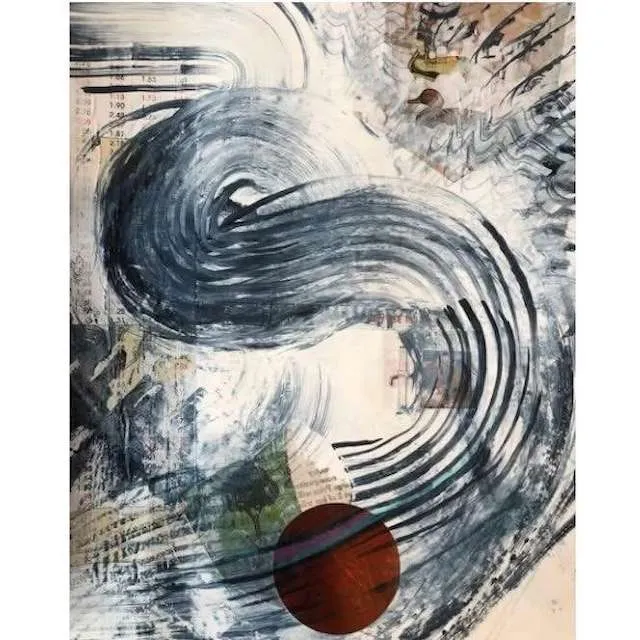
With thanks to the artists Kerri Smith and Jennifer Anderson for the use of their paintings.
