

Jeff Carreira: Welcome Mary. This issue of The Artist of Possibility is a contemplation about spiritual activism. What has come out of our interviews on this subject, is that spiritual activism is any form of activism that is fuelled by a spiritual connection. It can be activism that is inspired by a spiritual vision of some kind. And it can be an activism, like that of Sri Aurobindo, that is aimed at the evolution of consciousness through the active pursuit of spiritual awakening. In your case, you devoted your life to spiritual pursuit from a young age, and it was more recently that you became an activist.
Mary Adams: Yes, that’s true. At the same time the threads of political awareness globally, particularly social justice issues, have been with me from very early on.
Jeff : What inspired you to become as actively involved as you are now?
Why Activism?
Mary: I have been mainly involved in climate activism in the form of non-violent civil disobedience. And to be honest, I wasn’t expecting that at this point in my life. In terms of how I got here, I remember being at a family event when I was maybe 13 or 14 years old and thinking, is this what life is about? Is this it? There was nothing specifically ‘wrong’ but I felt the smallness of our conventional human lives. This got me started on a spiritual quest that eventually led to the activism I am currently involved in.
I spent many years looking for the deeper meaning of existence. I wanted to know why we’re here. My spiritual seeking was also aimed at trying to make sense of the world. Much of my younger adult life was in India, including two summers with the spiritual master, Nisargadatta Maharaj, which we have talked about on previous podcasts. In the end I joined the intentional community of a spiritual teacher named Andrew Cohen, which is where you and I met. Initially Andrew taught in the nondual tradition of [Eastern] enlightenment. It was all about waking up or self-realisation. But later he made a transition and started looking at the relationship between consciousness and the world, culture – the creative potential of being spiritually awake.

That transition spoke very deeply to me. I had never met a spiritual teacher who emphasized the connection between spiritual enlightenment and the ‘world’ as much as Andrew Cohen. And this was probably why I stayed in the community for so long, despite the problems that developed.
Interestingly though, when I was studying South Asian, and specifically Indian, philosophy at university, the concept of dharma expressed throughout the Upanishads made profound sense to me. This is because it’s all about the relationship between the Cosmos, or the Absolute/God on one hand, and human life, human society on the other. The basis of Indian philosophy is rooted in the recognition that the ‘world’ is not separate from spirit, and one’s whole life is about realising, and manifesting that higher spirit as fully as one can.
Recognising the connection between spirit and our lives gave me a deep sense of purpose. When the intentional community you and I were part of collapsed, I spent two years trying to understand what had happened. Then I moved to London with my partner, Steve Brett. We started hosting conversations or salons in our living room. We began attending events and meeting different people, and we found that there are a lot of people actively doing significant work in the world who are motivated by something deep within themselves. We were drawn to that, so for us ‘activism’ always had a spiritual basis.
A Natural Transition
The transition to activism was a natural one for me because I’ve always wanted to understand how we could best live together, in all our diversity, on this planet. As I learned more about the climate crisis, I began to see the existential threat this actually is. There have always been global threats, but this felt different.

In 2017, I participated in an intensive induction into the science of the climate crisis. I wanted to know the facts. Al Gore (former US Vice President) was bringing together groups of scientists annually to give seminars on climate change, to create a body of informed public. I attended one of these. It was powerful. The data was devastating. But what impacted me the most was seeing so many scientists so deeply affected. I remember an expert on the Australian barrier reef weeping. Their deep concern and even heartbreak made an irreversible impression. I came back to London thinking about my two little grandchildren and feeling the very real impact on their generation. The climate crisis was no longer abstract for me.
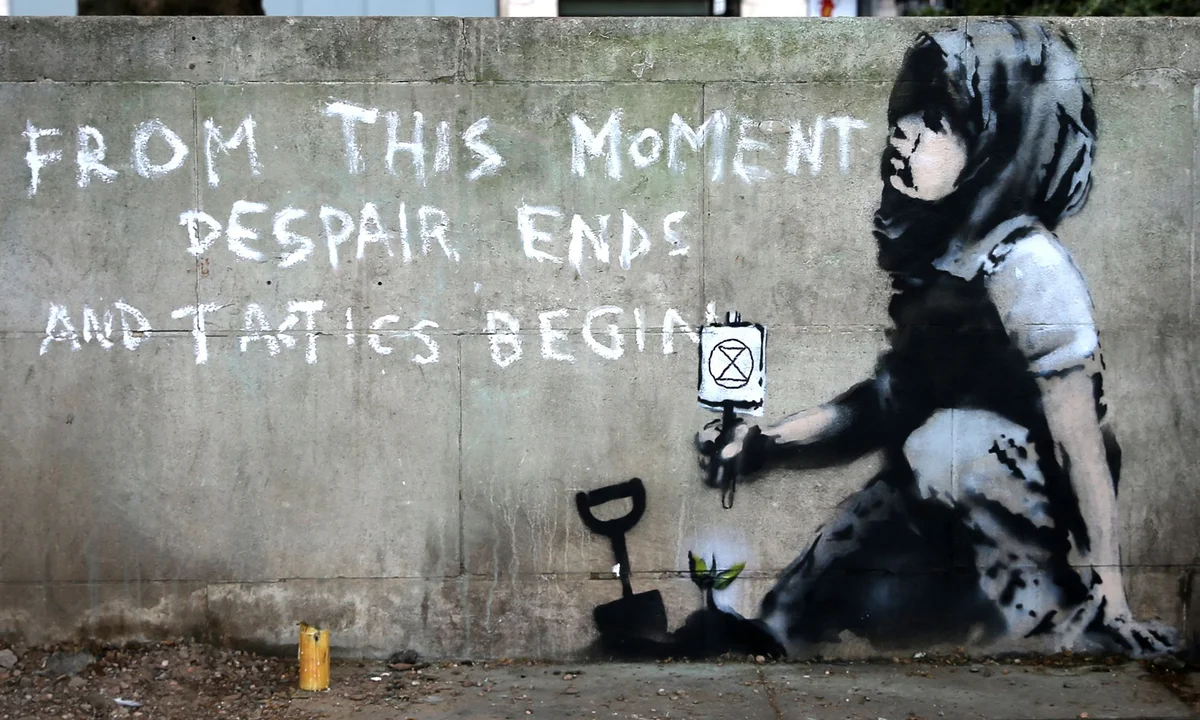
I soon began to look into Extinction Rebellion, a climate movement building in Britain around this time. I went to their first major action in April 2019. Thirty thousand people turned up and occupied central London for almost 10 days. It was extraordinary. But what really drew me in were the ten principles of the movement, grounded in an ethos of non-violence.
Jeff: Can you explain what the Extinction Rebellion is?
Mary: It started with a small group. An organic farmer named Roger Hallam, Gail Bradbrook a scientist, and several others including Claire O’Farrell, who is still one of the central figures in the organisation. They came together from different backgrounds but were all passionate about the urgency for change. They sought to create a social movement that both challenged the government’s apathy around the climate crisis, and could lead to the conditions for systems transformation.

This was different to simply staging a protest. It was more about engaging in non-violent civil disobedience as an instrument to bring about change. This attracted me partly because I had lived in India for many years, and I was aware of Mahatma Gandhi and his commitment to non-violent action in bringing about the end of colonial rule by the British.
I’d done a lot of reading about colonialism and the movements that came out of this, so I was aware of the power of non-violent civil disobedience as a mechanism for societal transformation. This is the philosophy behind Extinction Rebellion. In the first few years XR (Extinction Rebellion) staged huge non-violent actions in central London, basically shutting the city down for days. That really brought the public’s attention to the issue, which was the aim. As a result, the British Parliament declared a climate emergency, and I saw first-hand what an effect we [ordinary citizens] could have.
So, Steve and I completed training in non-violent activism and became very involved, including educating the public on the climate crisis and civil disobedience. We saw this as non-separate from spiritual practice. You engage in a lot of rigorous training to go out on these actions. Often, we think of activism as being ‘against’ something, whereas to me, it’s action for transformation, for positive change. And it’s done with tremendous precision and attention in a very disciplined way.
When you go out on an action, it’s important to be very clear about why you’re doing it. What is your deepest reason for doing this? This is what gives you the resilience and the right mindset for nonviolent civil disobedience, because you will inevitably find yourself obstructing or inconveniencing the public. You are trained to empathize with the people you are obstructing, no matter how they respond. You learn to let go and surrender to the action, and whatever happens.
Some people think by engaging in activism I’ve given up the spiritual life. I think this comes from a misunderstanding of activism. For me, activism emerged as a response to something larger than myself. In this sense, it was choiceless.
At a certain point, the government stopped responding to Extinction Rebellion’s actions. The initial impact died down. Then I heard a talk given by Roger Hallam titled, ‘Our Responsibilities at this Time,’ where he was calling for more radical forms of non-violent civil disobedience. Despite myself I felt called to participate in actions with much higher stakes. That meant being arrested, potential court hearings, possible prison time, not to mention public animosity stoked by right-wing media.

I passed Roger’s talk on to Steve to listen to. I didn’t say a word to him about how it had impacted me. Steve had exactly the same response. I think the spiritual impulse is fundamentally one of love. There’s an inherent intelligence in Being. There’s also an inherent care in Being. Spiritual experience, to me, is not just about one’s personal realisation or enlightenment. It’s also about discovering what the implications of spiritual insight are for the world. The spiritual impulse, which is about love, is positively motivating. It’s a creative positivity. It’s about making the manifest realm ‘better’. In this way I see it as evolutionary, but it’s also protective. When I listened to Roger’s talk about taking more radical action because the government was doing nothing, I felt that protective impulse, a deep call of responsibility.

I also understood that I am fortunate to be in a position to do this. I don’t have a young family to care for. I’m no longer formally working, or have a career where others depend on me. Like many of us, I’ve been through hard times in my life, but I’ve also lived an incredibly privileged life where I’ve been able to make my own choices most of the time. I understood that I was ‘free’ to respond to this moment. And if not me, then who?
From years of study and just taking in what’s happening around us, I came to realise there’s no one at the helm so to speak. The future is at risk, imperilled. In the face of the enormity of the climate and biodiversity crisis, and the speed at which it’s unfolding, the irresponsibility and lack of political will to take appropriate action is extraordinary. I felt ‘I’ve got to respond’. And that’s the connection to my spiritual past.
Climate is not the Problem
Jeff: You said initially that the movement saw some success, then it slowed down, and you started organising and participating in more radical actions. How do you feel that’s going? Do you feel hopeful about the planet, about the environment, about our future?
Mary: I do feel hopeful. Although I don’t know if ‘hopeful’ is the right word. But I feel positive. It’s not because there’s been a lot of change at the political level. There’s clearly a lot that has to happen, but I feel positive because all kinds of activism are being taken up, especially by younger people. Steve and I started a forum called 3rd Space where we profile people who are making changes to the system and expressing that deeper spiritual impulse. Even though I know we’re on an incredibly dangerous course and there’s still enormous political apathy, what gives me hope is seeing that a lot of the changes that need to happen, alternative ways of thinking and acting that are crucial, whether in economics, energy, agriculture, or community building, are starting to happen, and not only on the fringe. They’re all connected.

Ultimately, the problem is not the climate. The climate crisis has arisen out of an ideology that affects everything. It’s that ideology that needs to change. If you want to take it to a spiritual level, you could say it’s an ideology that’s devoid of the recognition that we are one, that we are a single living, breathing, interconnected and interdependent entity. That disconnection has created policies, it’s created theories, it’s created systems that have led us to where we are, and that has not changed. The people who are ultimately directing our common destiny are still operating from that ideology. But at the same time, what gives me hope is that there are many more people in the North and the South, in the East and the West, who are waking up to the fact that we’ve become so disconnected from our source, from who we really are. And in different ways, in different cultures, and in different contexts, people are starting to respond, to take action. And that includes the kind of activism we’re talking about, but it also includes people just creating new ways of doing things in their communities, their cities, and in their countries.
This is coming from the ground up. It’s coming from experts who understand complex systems, and it’s coming from ancient wisdom that’s being brought into contemporary forms. There’s a melding of the innovation of the West with the wisdom of the East. There are multiple ways this is happening, but it’s coming from the human spirit as it recognises that somewhere we’ve gone profoundly off course. And because of that, I feel hopeful. But I also realise there’s a critical time element. And I think, to be honest, we’re going to go through a lot more intense suffering on this planet before we get to the other side. Things are degrading quickly, and our future is largely in the hands of people who are operating from an outdated worldview. That’s why we are all needed.
